
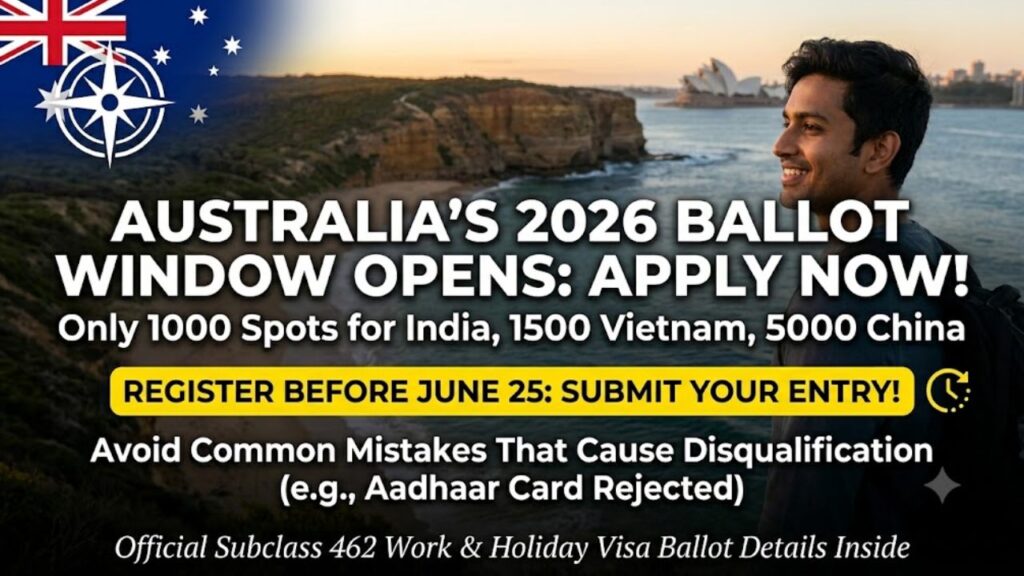
For young adults looking to spend a year working and traveling across Australia, the window to secure a highly sought-after visa is about to open. The Australian government has launched its random electronic ballot for the 2026–2027 Subclass 462 Work and Holiday Visa, offering eligible 18-to-30-year-olds from India, China, and Vietnam a chance to live down under for up to 12 months.
However, securing a spot is far from guaranteed. With skyrocketing demand and strict country caps, thousands of hopeful applicants are disqualified each year due to simple paperwork errors before their names are even drawn.
A Strict Three-Week Window
Unlike standard visa programs, applicants cannot apply whenever they choose. The selection process relies on a strict, non-negotiable three-week registration window. Missing this timeline means waiting until the following year for another opportunity.
- Registration Opens: Thursday, June 4, 2026
- Registration Closes: Thursday, June 25, 2026
- Selection Drawings: Conducted randomly between July 2, 2026, and April 30, 2027
To enter the lottery pool, applicants must submit a registration via the official ImmiAccount portal and pay a non-refundable AUD $25 fee.
High Demand and Low Odds
The ballot system was introduced to manage a massive influx of interest that far outpaces available visas. For the 2026–2027 cycle, the caps on available places remain highly competitive:
- China: 5,000 places
- Vietnam: 1,500 places
- India: 1,000 places
The competition can be exceptionally steep. In a previous ballot cycle, more than 98,000 Indian nationals registered for the 1,000 available spots, resulting in a selection rate of just 1.1%. Because the electronic drawing is entirely random, submitting an entry early does not provide an advantage, but ensuring absolute accuracy is critical.
The Paperwork Pitfalls That Trigger Disqualification
The Department of Home Affairs maintains strict guidelines regarding national identity documents. A single typographical error or the submission of an incorrect ID type will result in an immediate rejection from the pool.
For Indian citizens, the registration requires a Permanent Account Number (PAN) card. While Aadhaar cards are standard for many domestic processes, they are explicitly not accepted for this ballot and will cause an application to be discarded.
Vietnamese citizens must register using their current 12-digit Citizen Identification Card. Attempting to use an older 9-digit card, even if it is technically unexpired, will lead to disqualification. Chinese applicants must provide a current and valid Chinese Resident Identity Card.
Verifying Qualifications and Avoiding Scams
Because the selection process is highly competitive, misleading rumors often circulate online. Prospective applicants should be aware of core eligibility criteria that cannot be bypassed:
- Language Requirements: Applicants must demonstrate “Functional English” proficiency. This requires providing an IELTS score of at least 4.5, or an equivalent score from approved tests like the PTE, TOEFL, or OET.
- Education Standards: Candidates must have completed a minimum of two years of post-secondary or tertiary education.
- Financial Proof: Applicants must hold at least AUD $5,000 in savings to demonstrate they can support themselves during their initial stay.
Preparing for the 28-Day Turnaround
Those fortunate enough to be selected from the ballot face a tight timeline. Once notified, successful registrants have exactly 28 calendar days to submit their comprehensive visa application and pay the AUD $670 visa fee.
Given the short turnaround time, preparing documents in advance—such as certified passport scans, bank statements, and language test results—is highly recommended.
Additionally, applicants are advised to exercise caution on social media and messaging groups. Sharing images of passports or national ID cards while seeking advice increases the risk of identity theft and fraudulent duplicate applications.
Leave a Reply