

No travel history? You can still get a Schengen visa approved — plenty of Indian applicants do it every year.
The problem is, most people get stuck on the wrong thing. They overthink travel history, assume a blank passport is a red flag, and sometimes even delay their Europe plans because of it.
In reality, travel history is just one part of the picture. What actually matters becomes much clearer once you understand the full set of documents required for a Schengen visa for Indian applicants — because embassies don’t judge your application based on stamps alone.
This guide will walk you through how travel history really affects your approval chances, what carries more weight, and how to build a strong application from scratch.
Table of Contents
Does Travel History Affect Schengen Visa Approval?
Yes, travel history helps — but it is not mandatory.
Embassies assess your entire profile, not just your travel history. According to official guidance from the European Commission, visa decisions are based on an overall risk assessment — including your financial situation, purpose of travel, and intent to return — rather than any single factor.”
How Travel History Impacts Schengen Visa Approval (What Visa Officers Actually Look At)
Positive Impact: What Good Travel History Signals
When you have prior international travel — especially to countries like the UAE, UK, USA, or Singapore — it tells the visa officer several important things:
- You have travelled before and returned on time (no overstay history).
- You understand and respect immigration rules.
- You have demonstrated financial capacity for international travel in the past.
- You are a low-risk applicant with a proven track record.
A prior US or UK visa stamp, in particular, is treated as a strong trust signal by Schengen embassies, since these countries have stringent screening processes themselves.
Negative Impact: What Hurts Your Application
Travel history can work against you if it includes:
- A previous Schengen visa overstay (this is a serious red flag).
- A visa refusal from any Schengen country in the past (must be declared on the form).
- Travel with no clear pattern — multiple short trips to high-risk countries with no financial justification.
Note: You must disclose all previous Schengen visa refusals. Hiding them is a direct ground for rejection and can result in a long-term ban.
The Neutral Reality: No History Is Not Disqualifying
Here is what most guides miss: no travel history is completely neutral if your supporting documents are strong. Embassies do not reject applications for lacking travel history — they reject applications for lacking evidence of intent to return home and financial stability.
If you are a salaried professional, business owner, or student with solid documentation, your travel history score is simply “not applicable” — not negative.
What Matters MORE Than Travel History
This is the section that will change how you approach your application. The following five factors carry significantly more weight than any passport stamp.
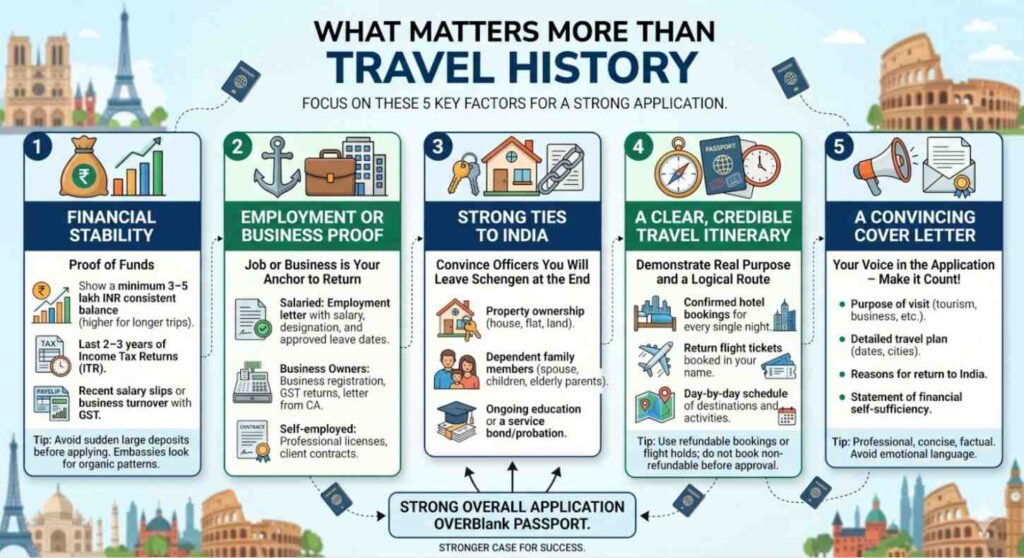
1. Financial Stability
Embassies want to see that you can afford your trip without being a financial burden on the Schengen state. This means:
- Proof of Funds showing a minimum of 3–5 lakh INR (higher for longer trips) with consistent balance over 3–6 months.
- Income Tax Returns (ITR) for the last 2–3 years showing stable income.
- Salary slips for the past 3–6 months (for salaried applicants).
- Business turnover and GST returns (for self-employed applicants).
A sudden large deposit right before applying is a red flag. Embassies look for organic financial patterns, not last-minute cash transfers.
2. Employment or Business Proof
Your job or business is your anchor. It is the single most convincing argument that you will return home after your trip.
- Salaried employees: Submit your employment letter on company letterhead, stating your designation, salary, and approved leave dates.
- Business owners: Submit business registration documents, GST returns, and a letter from your CA confirming your role.
- Self-employed: Provide professional licences, client contracts, or other proof of active professional commitments.
If you are currently employed at a reputable company or run an established business, this alone can override a blank passport.
3. Strong Ties to India
This is the psychological core of your application. Every visa officer is asking one silent question: will this person leave Schengen territory at the end of their trip? Your ties to India are your answer.
- Property ownership (house, flat, land) in India.
- Dependent family members (spouse, children, elderly parents).
- Ongoing education (college enrollment, exam schedules).
- A service bond or probation period at your company.
Include supporting documents for whichever of these apply to you — property papers, marriage certificate, school admission letters, etc.
4. A Clear, Credible Travel Itinerary
A vague itinerary is one of the most avoidable rejection reasons. Your day-by-day plan must demonstrate that your trip has a real purpose and a logical route.
- Confirmed hotel bookings for every night (not just the first few days).
- Return flight tickets booked in your name.
- A day-by-day schedule covering key destinations and activities.
- All bookings consistent with your stated travel dates.
Do not book non-refundable flights before your visa is approved. Use refundable hotel bookings and flight holds/dummy tickets from recognised services.
5. A Convincing Cover Letter
Your cover letter is your voice in the application. It is often the difference between an approved and a rejected file — especially for first-time applicants.
A strong cover letter must include:
- Purpose of visit (tourism, business meeting, family visit, etc.).
- Your detailed travel plan (dates, cities, activities).
- Why you will return to India (job, family, business commitments).
- Your financial self-sufficiency statement.
- Any additional context the officer should know.
Keep it professional, concise (one page), and factual. Avoid emotional language or over-explanation.
Travel History and Approval Chances
| Scenario | Profile | Approval Chances |
| No Travel History | Salaried IT professional, 3 lakh+ bank balance, confirmed hotel & flights, strong cover letter | High — strong financial + employment profile compensates fully |
| Basic Travel History | Has UAE or Thailand visa stamp, decent finances, employed | Moderate-High — prior compliance adds credibility to overall profile |
| Strong Travel History | US/UK visa or prior Schengen, strong finances, business owner | Very High — robust profile significantly reduces scrutiny |
Key Takeaway: It is not about whether you have travel history — it is about the overall story your documents tell.
Common Mistakes That Lead to Schengen Visa Rejection
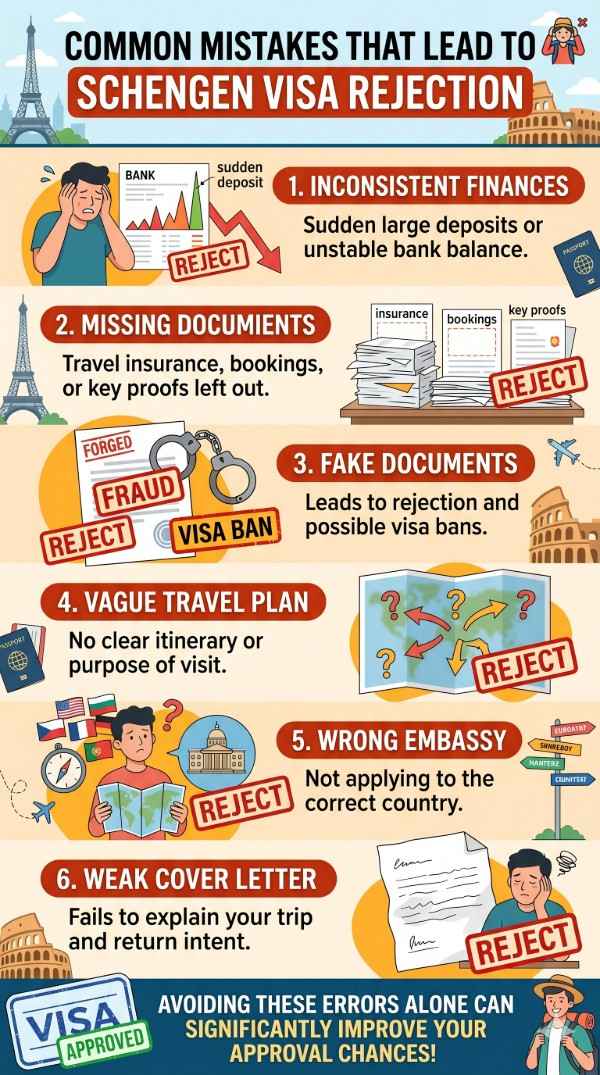
Most Schengen visa rejections happen due to small but avoidable mistakes. The most common ones include:
- Inconsistent finances: Sudden large deposits or unstable bank balance
- Missing documents: Travel insurance, bookings, or key proofs left out
- Fake documents: Leads to rejection and possible visa bans
- Vague travel plan: No clear itinerary or purpose of visit
- Wrong embassy: Not applying to the correct country
- Weak cover letter: Fails to explain your trip and return intent
Avoiding these errors alone can significantly improve your approval chances.
How to Get a Schengen Visa Without Travel History: Step-by-Step Strategy
Follow this exact process if you are applying for the first time with no international travel history:
- Step 1 — Build your financial profile 3–6 months before applying.
Maintain a healthy, stable bank balance without sudden spikes. Get your ITR filed. Collect salary slips. Do this well in advance — this cannot be rushed.
- Step 2 — Gather airtight employment or business proof.
Get a formal leave approval letter from your employer on company letterhead. Ensure it explicitly states your designation, tenure, approved leave period, and confirmation that your job is secure upon return.
- Step 3 — Plan and book a clear, day-by-day itinerary.
Book refundable hotels for every night of your stay. Use a dummy ticket service for your flight (e.g., Visa Reservation or Fly Onward). Prepare a printed, day-wise travel plan including cities, hotels, and planned activities.
- Step 4 — Write a powerful, one-page cover letter.
Outline your trip purpose, travel plan, financial standing, and return commitments clearly and professionally. End with a statement that you will comply with all visa conditions and depart on or before the stated date.
- Step 5 — Choose the right embassy and double-check your documents.
Apply to the embassy of the country where you will spend the most nights. Review the checklist on the embassy’s official website twice. Organise documents in the exact sequence required. Check that all pages of your passport are clear and legible.
Pro Tip: Countries like Germany, France, and the Netherlands have relatively higher approval rates for Indian applicants with strong financial profiles, even without prior travel history.
Frequently Asked Questions (FAQs)
Can One Get a Schengen Visa Without Travel History?
This is one of the most common concerns among first-time applicants. The short answer is yes — you absolutely can. Every year, many Indian applicants receive their first Schengen visa without any prior international travel. What matters is not your past travel, but how strong and consistent your current application looks on paper.
Can I get a Schengen visa for the first time with no prior international travel?
Yes, absolutely. Many Indian professionals and students get approved for their first Schengen visa with no prior international travel. The key is submitting complete, consistent, and well-organised documentation.
Which travel history is considered best for Schengen visa applications?
In order of preference: prior Schengen visa > US or UK visa > Singapore or Japan visa > UAE or Thailand. Even a single US or UK stamp significantly reduces scrutiny from Schengen embassies.
What increases approval chances the most for Indian applicants?
A combination of: (1) 3–6 months of healthy bank statements, (2) a current employment letter with clear leave approval, (3) confirmed, refundable bookings for the entire trip, and (4) a well-written cover letter explaining your ties to India.
How much bank balance is required for a Schengen visa from India?
There is no official minimum, but as a rule of thumb, aim for at least 3–5 lakh INR for a 10–14 day trip. The balance should reflect your income level and be consistent over 3–6 months — not artificially inflated just before application.
Which embassy should I apply to for a Schengen visa?
Apply to the embassy of the country where you will spend the most nights on your trip. If your trip is split equally between countries, apply to the embassy of your first port of entry (your first Schengen country).
Conclusion
At the end of the day, if you’re still wondering does travel history affect Schengen visa approval, the honest answer is simple: it helps, but it’s not what makes or breaks your application.
Visa officers aren’t just flipping through your passport looking for stamps. They’re trying to understand your overall profile. Do you have stable finances? A job or business to return to? A clear and realistic travel plan? These are the things that actually matter.
Instead of stressing over a blank passport, put your effort into what you can control. Keep your finances clean and consistent, get a proper employment letter, plan your itinerary properly, and write a clear cover letter that explains your trip.
And one practical tip that makes a real difference—start preparing at least 2–3 months in advance. When your documents are well-organised and your story makes sense, travel history becomes just a bonus, not a requirement.
Leave a Reply