
Schengen Visa Rejection Reasons are not random or unclear—they are strictly defined under Article 32 of the EU Visa Code. If your application gets refused, it always maps back to one of 12 legal grounds. Understanding these reasons—and how to fix them—is the key to improving your approval chances.
Applying for a Schengen visa and getting rejected is one of those experiences that feels disproportionately frustrating. You’ve spent weeks assembling documents, paying non-refundable fees, and planning an itinerary—only to receive a one-page refusal that seems, at first glance, opaque.
It isn’t.
The single most important thing most applicants misunderstand is this: Schengen visa refusals are not discretionary in the casual sense. They are tightly governed by Article 32 of EU Regulation 810/2009—the EU Visa Code.
If you understand these rules—and follow a structured Schengen visa checklist—your approval chances increase significantly.
There are exactly 12 legal grounds on which a visa can be refused. Nothing more, nothing less. If you understand those 12 grounds, you understand the system.
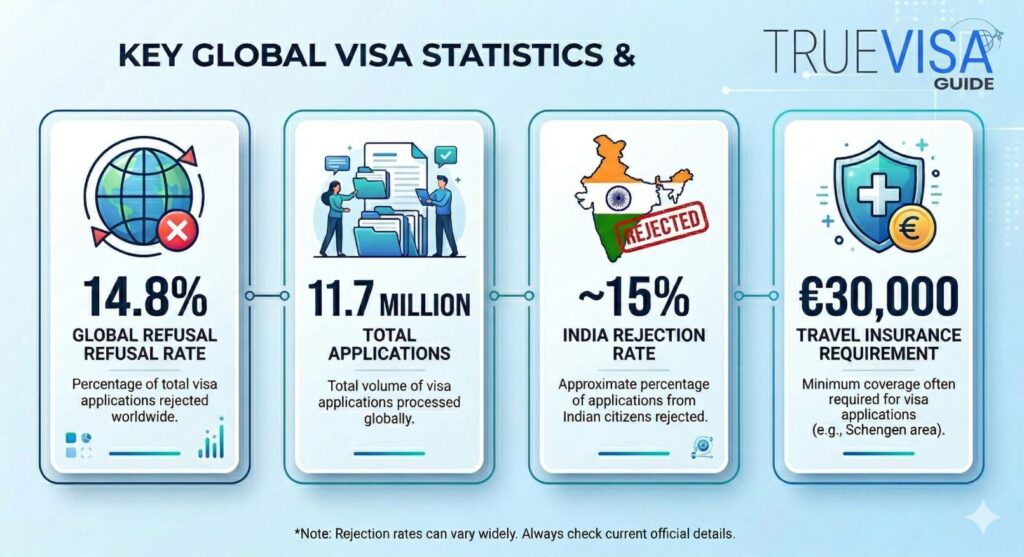
The data reinforces this structure. In 2025, roughly 1 in 7 applications was refused globally—14.8% across 11.7 million applications. Indian applicants sat slightly above that, at around 15%, translating to roughly 165,000 refusals. Those numbers sound intimidating until you realise something else: the majority of these refusals are avoidable.
Most applicants are not rejected because they are ineligible. They are rejected because their application doesn’t convincingly tell a coherent, verifiable story.
Table of Contents
Why Does a Schengen Visa Get Rejected?
A Schengen refusal is not a matter of “impression”—it is a structured legal decision. Every rejection must map back to a specific clause under Article 32. Once you internalise that, the process becomes far less mysterious.
What has changed in recent years—especially by 2026—is how applications are assessed. It’s no longer a checklist exercise. It’s closer to profile evaluation.
A visa officer today is effectively asking: does this application make sense as a whole?
They look at financial behaviour over several months, not just your closing balance. They examine whether your employment situation plausibly supports your leave. They check if your travel history reflects compliance. They read your itinerary and compare it against your bookings. And most critically, they assess whether you are likely to return.
With the Entry/Exit System (EES) now active, this scrutiny is backed by data. Your past entries, exits, and overstays are no longer inferred from passport stamps—they are digitally recorded and shared across the system. That has quietly raised the bar.
The 12 Schengen Visa Rejection Reasons (With Fixes)
1. Weak or Missing Proof of Return Intent
If there’s one idea that drives the entire decision, it’s this: return intent. Everything else comes after that.
Visa officers aren’t asking whether you can travel. They’re asking whether you’ll come back.
They look for “ties”—things that anchor you to your home country. A stable job, property, family responsibilities, financial commitments. When those signals are missing or weak, the perceived risk goes up.
If you’re unsure how to present this properly, it helps to structure your application alongside a strong visa cover letter format that clearly explains your situation.
A common mistake is thinking money can compensate for this. It can’t. Someone with a strong bank balance but no clear ties is still seen as high risk.
How to fix this:
- Provide a detailed employment letter with approved leave
- Show property ownership or active loan repayments
- Include evidence of business, education, or dependents
- Demonstrate continuity—not just status
2. Insufficient or Unbelievable Financial Proof
Most applicants focus on the final balance in their account. That’s not what officers focus on.
A consistent financial profile is far more important. If you’re unsure how much is enough, refer to a detailed breakdown of minimum bank balance for Schengen visa to align with embassy expectations.
They look at patterns—how money comes in, how it’s spent, and whether the overall story makes sense.
Large, last-minute deposits are one of the quickest ways to damage credibility. They often look like an attempt to artificially strengthen the application.
How to fix this:
- Maintain steady balances over 3–6 months
- Aim for €100–€120 per day of travel
- Back it with income proof—salary, ITRs, business records
- If sponsored, ensure the sponsor’s profile is equally credible
3. Invalid or Insufficient Travel Insurance
This is one of the most avoidable rejection reasons—and still one of the most common.
The requirements are strict: at least €30,000 coverage, valid across all Schengen countries, covering medical emergencies and repatriation, and aligned exactly with your travel dates.
Even a one-day mismatch can lead to rejection.
How to fix this:
- Read the certificate carefully, not just the product summary
- Make sure the dates match your travel exactly
- Confirm that “Schengen-wide validity” is clearly stated
4. Unclear or Vague Purpose of Travel
Many applications fail here—not because the purpose is invalid, but because it isn’t clearly presented.
Saying “France for 14 days” while only showing a few nights of bookings raises questions. It can look incomplete—or worse, fabricated.
Your application should feel like a well-thought-out plan, not a rough idea.
A properly structured itinerary helps. If you’re unsure how to build one, follow a day-by-day travel itinerary for visa that aligns bookings, travel dates, and activities.
How to fix this:
- Provide a realistic, day-by-day itinerary
- Align bookings with your dates and locations
- Include supporting letters for business or family visits
5. Incomplete or Incorrect Documentation
This is where even strong applications can fall apart.
Small issues—spelling inconsistencies, missing signatures, incomplete forms—signal carelessness. And in a process built entirely on documents, that matters.
How to fix this:
- Follow the exact embassy checklist
- Keep names consistent across all documents
- Have someone review your application end-to-end
6. False, Forged, or Unverifiable Documents
There’s no grey area here. If a document is false, the application is rejected—and it can lead to a long-term ban.
Verification is standard practice. Banks get called. Bookings get checked.
How to fix this:
- Use only genuine documents
- Avoid “dummy” bookings
- If your profile isn’t ready, wait before applying
7. Previous Overstay in the Schengen Area
With EES now in place, overstays are clearly recorded.
Even a short overstay can significantly weaken your profile.
How to fix this:
- There’s no quick fix
- Give it time, rebuild your profile, and be transparent
8. SIS Alert (Schengen Information System Flag)
An SIS alert can override everything else in your application.
Even a strong profile won’t matter if an alert is active.
How to fix this:
- Check whether an alert exists
- If it’s incorrect, challenge it through the proper legal process
9. Passport Issues
This one is simple, but people still overlook it. Your passport needs to meet all the basic requirements—validity, condition, and enough blank pages. Even small issues here can cause problems.
How to fix this:
- If your passport is close to expiring, renew it early instead of taking a risk
- Attach your old passports as well—it helps show your travel history
10. Criminal Record or Security Risk
Background checks are a normal part of the process. If there’s a serious offence on record, approval becomes very difficult.
That said, not every issue leads to rejection—it often depends on how you present it.
How to fix this:
- Include a police clearance certificate where required
- If there’s something in your past, be upfront about it instead of hiding it
11. Undisclosed Previous Visa Refusals
A lot of applicants think older visa refusals don’t matter anymore. They do.
What usually causes bigger trouble is not mentioning them at all. Non-disclosure tends to raise more concern than the refusal itself.
How to fix this:
- Mention all past visa refusals honestly
- Briefly explain what’s different in your situation now
12. Exceeding the 90/180-Day Rule
This rule sounds technical, and that’s probably why it confuses so many people. But it’s strictly tracked.
If you’ve already used up your allowed days, your application can be rejected regardless of everything else.
How to fix this:
- Double-check how many days you’ve already spent in the Schengen area
- If you need to stay longer, look into a long-stay visa instead
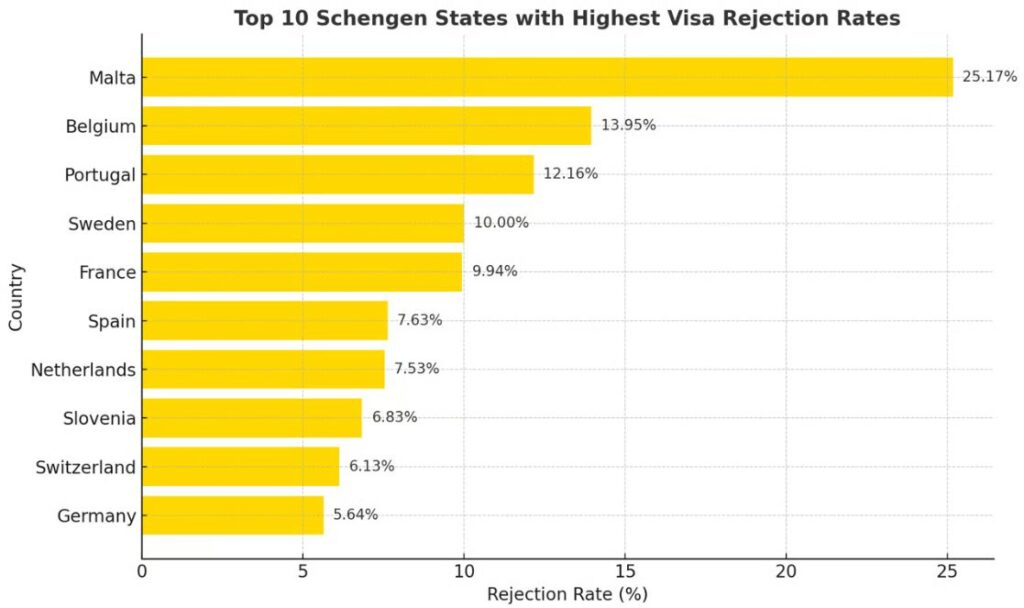
Schengen Visa Rejection Rates by Country (2023 vs 2025
How Much Money Do You Actually Need to Show?
The informal benchmark remains €100–€120 per day. But in practice, consistency matters more than totals.
A steady, explainable financial profile will outperform a large but erratic balance every time.
Travel Insurance: The Silent Rejection Cause Most Applicants Ignore
This is less about complexity and more about precision. The requirements are simple—but unforgiving.
EES & ETIAS: What Changed in 2025–2026
EES has fundamentally changed the system by removing ambiguity. Your travel record is now digital, centralised, and permanent.
ETIAS will extend background checks further, even if it primarily targets visa-exempt travellers.
The direction is clear: less discretion, more data.
What to Do After a Schengen Visa Rejection
Appeals exist, but they are procedural tools—not magic fixes. They work best when something was objectively mishandled.
For most applicants, the practical route is to step back, fix the underlying issue, and reapply with a materially stronger file.
Final Pre-Submission Approval Checklist
- Valid passport
- Completed application
- Correct photos
- Valid insurance
- Bank statements
- Employment letter
- Travel itinerary
- Hotel bookings
- Flight reservation
- Cover letter
- Refusals disclosed
- Name consistency
- 90/180 rule checked
Frequently Asked Questions
1. Why do Schengen visas get rejected?
Weak job proof, messy travel plans, low or suspicious funds, or bad insurance… any of these can sink your application. Sometimes it’s not even big—one sloppy document is enough.
2. How soon can I reapply after a rejection?
Technically? The next day.
But that’s a bad move if nothing has changed. Fix the problem first—then apply. Otherwise, you’re just repeating the same mistake.
3. Should I appeal or just reapply?
Appeals sound good on paper. In reality, they’re slow and rarely work.
Unless the embassy clearly messed up, don’t waste time. Build a stronger file and reapply. That’s what usually gets results.
4. How much bank balance do I need?
People obsess over the final number. Wrong approach.
Yes, around €100–€120 per day is a rough guide. But what matters more? Your account history. If you dump a big amount right before applying, it raises eyebrows instantly.
5. Can travel insurance cause rejection?
Oh yes. Happens all the time.
If your insurance doesn’t match your travel dates exactly, or doesn’t cover €30,000 across all Schengen countries, you’re giving them an easy reason to refuse you.
6. Is the visa fee refundable if rejected?
No. Simple as that.
You pay for the process, not the result. Whether you get approved or rejected, that money is gone.
7. Does a previous rejection affect future applications?
It doesn’t ruin your chances—but it does put you under a microscope.
You must declare it. And more importantly, show what’s different now. If nothing has changed, expect the same outcome.
8. What does “unclear purpose of travel” mean?
It means your story doesn’t add up.
Your bookings don’t match. Your itinerary is vague. Or your profile doesn’t fit the visa type. To them, it looks like you’re hiding something—even if you’re not.
9. How can I show strong ties to my home country?
You need to prove you have reasons to come back. Real ones.
A stable job, approved leave, tax records, property, family responsibilities—these things matter. The stronger your roots, the safer you look.
10. Will new systems like EES and ETIAS affect visas?
Yes—and this is where things are tightening.
Every entry, exit, and overstay gets recorded now. No room for “adjustments” or gaps in your history. If something doesn’t match, it will show.
Disclaimer: This article is for informational purposes only and does not constitute legal advice.
Leave a Reply